FROM EDITOR

The two-day XIX Congress "Drug development and registration" was held on February 17 and 18, 2026, at the Sechenov University Congress Center in Moscow.

As part of the "Leadership Opinion" project, an open dialogue between two pharmaceutical industry experts took place. Igor E. Shohin, CEO of the LLC "Center of Pharmaceutical Analytics", discussed the key operating principles of the LLC "Center of Pharmaceutical Analytics" training center with Boris B. Sysuev, Doctor of Pharmaceutical Sciences and Professor at Moscow State University. The experts discussed how to build effective training for industry professionals.

The article presents a transcript of the report by D. M. Freistat, Chief Engineer of Glavсhimfarmprom, "On the Situation with the Production of Medicines". The report was presented on July 31, 1943, at a meeting of the Pharmacological Committee of the Scientific Medical Council of the People's Commissariat of Health of the USSR. The report lists the losses incurred by the domestic chemical and pharmaceutical industry in the first months of the war and its state by mid-1943. The list includes details of the medicines that have already been produced at the restored and newly built enterprises of the industry. The difficulties affecting the growth of medicine production were noted, and plans were announced for the introduction of new production facilities that would not only increase the production of traditional medicines, but also enable the development of new drugs. The main report was supplemented by representatives of Glavmedfarmprom and the Main Pharmacy Administration. They focused on the plans for 1944. The meeting's materials were planned to be presented at a conference of pharmacologists, therapists, representatives of the distribution chain, and representatives of industrial organizations to plan further actions by the industry to increase both the range of manufactured drugs and their tonnage production.

For any analytical laboratory, software efficiency and versatility are essential. The growing variety of equipment necessitates integrated solutions for managing different instruments, simplifying training, and speeding up method implementation. This article discusses Space CDS, a domestic web-based software developed by Labconcept Group, designed to automate the operation of analytical instruments from various manufacturers and of different types, such as HPLC, GC, spectrophotometers, and FTIR spectrometers. The software offers several significant advantages in management, data processing, and report generation, which facilitate its use and underscore its importance for modern laboratories operating according to GMP and ISO 17025 standards.
RESEARCH AND DEVELOPMENT OF NEW DRUG PRODUCTS

Introduction. Many compounds containing a tetrazole component are superior in efficacy to other antidiabetic drugs in preclinical studies, and some candidates are already in current trials. The widespread use of tetrazole derivatives to target diabetes-associated targets and therapies that maintain their stability provide the basis for the development of new, effective antidiabetic agents.
Aim. A study (in silico, synthesis, in vivo) of a series of hybrid 5-phenyltetrazole derivatives was conducted to identify and conduct experimental validation of promising compounds exhibiting hypoglycemic and anti-fat activity.
Materials and methods. The synthesis of hybrid heterocyclic compounds was accomplished by acylation of a series of heterocyclic derivatives of N-alkyl-5-aminotetrazole, 4-amino-4H-1,2,4-triazole-3-thiol, and 2-hydrazinyl-4,6-dimethylpyrimidine with 5-phenyltetrazol-2-ylacetic acid chloride.
Results and discussion. As a result of in silico (PASS, docking, scoring) study of biological activity in a series of 5-phenyltetrazole derivatives, the most promising "hybrid" (polynuclear) heterocyclic compounds were identified: N'-(4,6-dimethylpyrimidin-2-yl)-2-(5-phenyl-2H-tetrazol-2-yl)-acetohydrazide, N-(3-mercapto-4H-1,2,4-triazol-4-yl)-2-(5-phenyl-2H-tetrazol-2-yl)-acetamide, N-(1-methyl-1H-tetrazol-5-yl)-2-(5-phenyl-2H-tetrazol-2-yl)-acetamide, N-(2-methyl-2H-tetrazol-5-yl)-2-(5-phenyl-2H-tetrazol-2-yl)-acetamide and N-tert-butyl-2-({1-[2-(5-phenyl-2H-tetrazol-2-yl)acetamido]-1H-tetrazol-5-yl}thio)acetamide. These predictions are of interest as potential computer-aided means for the pharmacological correction of various metabolic phenomena. A rational method for synthesizing these compounds was developed and implemented, the structure and individuality of which were demonstrated using modern instrumental physicochemical methods. In vivo studies demonstrated that these heterocyclic compounds exhibit hypoglycemic and pronounced anti-lipid activity.
Conclusion. The study of hybrid 5-phenyltetrazole derivatives revealed pronounced hypoglycemic activity. It was found that the anti-lipid activity in this case is not directly related to the hypoglycemic effect, unlike the manifestation characteristic of the sensitizer metformin.

Introduction. Flavanonol dihydroquercetin (DHQ) is known for its pronounced antioxidant properties, which are associated with a wide range of biological activity of this compound. Due to the presence of two chiral centers at positions 2 and 3 of the benzopyranone ring, this flavonoid is characterized by the phenomenon of cis-trans isomerism. However, a comparative analysis of the antioxidant properties of DHQ diastereomers has not been performed before.
Aim. To evaluate the effect of diastereomeric composition on the reducing and radical scavenging properties of DHQ samples.
Materials and methods. The diastereomeric composition of the DHQ samples was controlled under reverse phase chromatography with UV detection. The antioxidant capacity was studied using a model of inhibition of radical cations of 2,2'-azino-bis-(3-ethylbenzothiazoline-6-sulfonic acid) diammonium salt (ABTS+•). The reducing ability of the DHQ samples was evaluated using a 5-(2,4-disulfophenyl)-3-(2-methoxy-4-nitrophenyl)-2-(4-nitrophenyl)-2H-tetrazolium monosodium salt (WST-8) model. Both tests were performed under the control of UV spectrophotometry.
Results and discussion. The chromatograms of the samples obtained at 288 nm are characterized by two peaks with retention times of 18.79 ± 0.08 and 19.87 ± 0.08 min, which correspond to trans- and cis-diastereomers of DHQ. After 6 minutes of DHQ samples containing 0.8, 3.7, and 9.5 % of the cis-isomer adding to the ABTS•+ solution, the optical density at 730 nm decreased by 0.588 ± 0.008, 0.581 ± 0.017, and 0.602 ± 0.012, respectively (α 0.05, p 0.2196, r 0.7857), while in WST-8 solutions at 450 nm for similar samples, an increase in optical density was observed by 0.178 ± 0.030, 0.222 ± 0.026, and 0.188 ± 0.036, respectively (α 0.05, p 0.5157, r 0.0284).
Conclusion. These results indicate that there is no significant effect of the diastereomeric composition on the antioxidant properties of the DHQ samples. Thus, the observed differences in the pharmacology of cis- and trans-DHQ should be explained by the selectivity of interaction with biological targets, rather than the free radicals scavenging activity.
PHARMACEUTICAL TECHNOLOGY
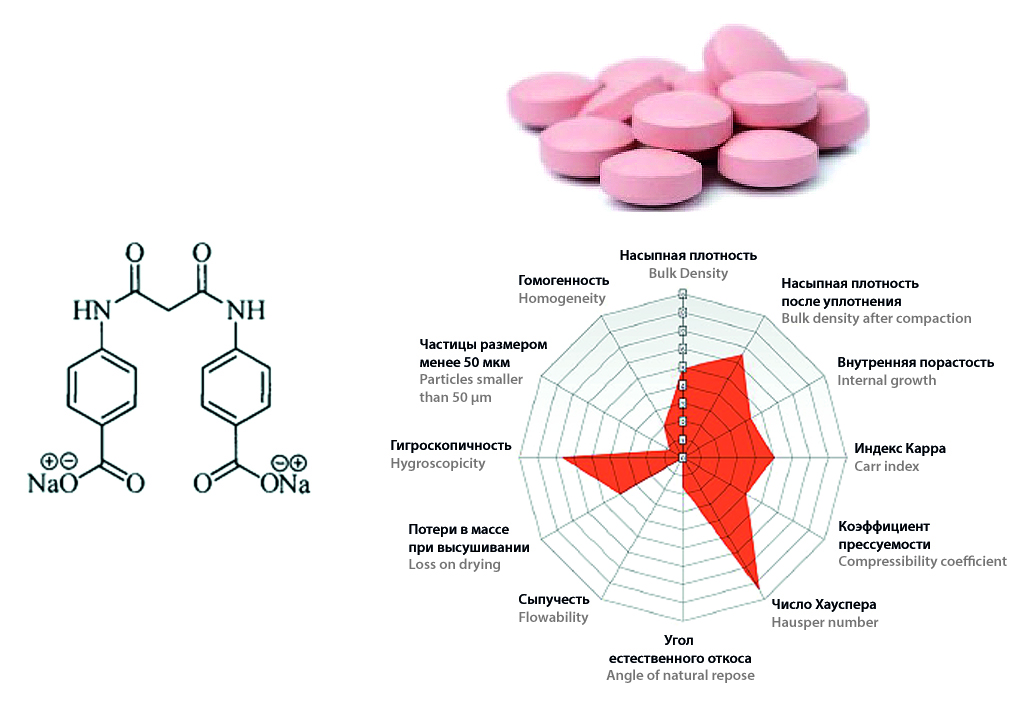
Introduction. Pharmaceutical development is a complex work, the main goal of which is to achieve the quality target product profile (QTPP). QTPP is formulated on the basis of a whole set of requirements for the drug, including pharmacopoeial, consumer, pharmacological, etc. The traditional empirical approach to the development of the composition and technology of the dosage form in this case seems to be labor and resource-intensive, while it does not fully achieve an understanding of all processes both from the point of view of technology and from the point of view of further stages of the life cycle of the drug. The Quality by Design (QbD) approach allows you to assess the impact of factors on processes, which, in turn, contributes to proactive risk management and the creation of robust technologies.
Aim. Demonstrate the comprehensive use of QbD tools, including expert systems (Sediment Delivery Model, SeDeM), experimental planning (Design of Experiment, DoE) and risk analysis, using the example of the development of prolonged-release tablets based on sodium 4,4’-(propanediamido)dibenzoate.
Materials and methods. The paper uses the original active pharmaceutical ingredient (API) – sodium 4,4’-(propanediamido) dibenzoate, modern excipients and polymers that provide prolonged release (ethylcellulose, hydroxypropyl methylcellulose, etc.). At the first stage, the SeDeM method was used to design the compositions. In the second step, screening DoE was used to optimize the release profile
Results and discussion. The SeDeM method made it possible to quantify and neutralize the risks associated with the unsatisfactory technological properties of the API. Compositions with satisfactory technological properties were designed and experimentally confirmed. As a result of DoE, it was found that HPMC provides the most complete and uniform release (more than 80% in 12 hours), close to zero-order release kinetics.
Conclusion. The comprehensive use of QbD tools made it possible to effectively and reasonably develop a robust composition of prolonged-release tablets based on sodium 4,4’-(propanediamido) dibenzoate, providing both the required technological properties and the required release profile.
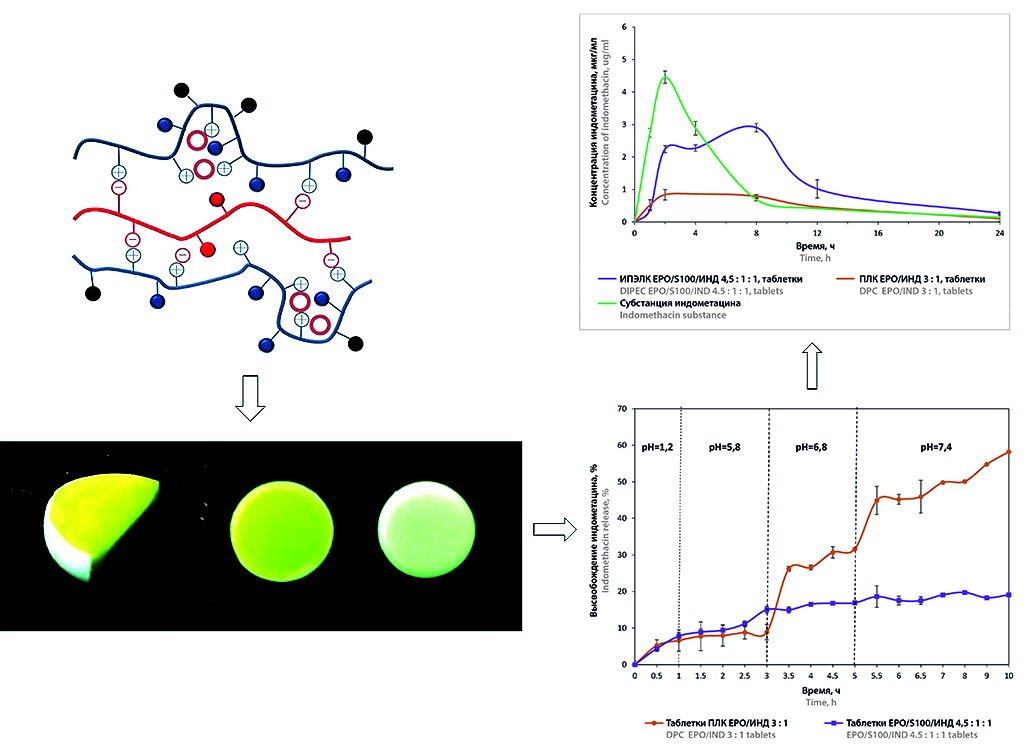
Introduction. Interpolyelectrolyte complexes (IPEC) are promising carriers for controlled drug delivery systems. The introduction of ionic API into delivery systems can lead to the formation of bonds with polyelectrolytes, which affects the release of the drug from the dosage form. Previously, a drug-polymer complex (DPC) based on Eudragit® EPO with indomethacin, as well as an drug-interpolyelectrolyte complex (DIPEC) with the participation of copolymers of Eudragit® EPO, Eudragit® S100 and indomethacin were obtained. The physicochemical properties of the optimal samples were assessed and the prospects for their use in controlled delivery systems of indomethacin were shown.
Aim. Comparative biopharmaceutical evaluation of drug-polymer and drug-interpolyelectrolyte complexes as oral controlled delivery systems for indomethacin.
Materials and methods. Drug-polymer complex based on Eudragit® EPO and indomethacin (DPC EPO/IND) and druginterpolyelectrolyte complex based on Eudragit® EPO, Eudragit® S100 and indomethacin (DIPEC EPO/S100/IND) were obtained at the molar ratio of components of 3 : 1 and 4.5 : 1 : 1, respectively. The release of indomethacin from DPC and DIPEC powders and tablets was assessed by apparatus II "Rotating Paddle" using a DT 828 dissolution tester (ERWEKA GmbH, Germany). The concentration of indomethacin was determined by UV spectrophotometry on a Lambda 25 spectrophotometer (PerkinElmer, USA) at a wavelength of 270 nm. Mathematical modeling of indomethacin release was performed using Microsoft Excel Office. Pharmacokinetic studies were performed on Soviet Chinchilla rabbits. The studied samples were administered orally, blood samples were taken from the ear at certain intervals of time after administration. The concentration of indomethacin in blood plasma was determined by HPLC on an LC-20 Prominence chromatograph (Shimadzu, Japan) with UV-detection. The main pharmacokinetic parameters were calculated using the Thermo Kinetica® program (Version 5.0, Build 5.00.11; Thermo Fisher Scientific, USA).
Results and discussion. The release profiles of indomethacin from DPC and DIPEC powders are characterized as "intestinal type", where the predominant mechanism is the process of relaxation of polymer chains during the release of the substance. The release of indomethacin from the tablet matrix based on DIPEC differs from the release profile from DIPEC powder and reaches 19 %. The release profile of indomethacin from DPC EPO/IND tablets is similar to the release profile from the powder and reaches 58 %. A hydrogel layer is formed on the surface of DIPEC tablets, which prevents the penetration of the dissolution medium into the matrix. The release of indomethacin from DIPEC EPO/S100/IND samples occurs due to the diffusion of the drug from the matrix. DPC and DIPEC in powder form have a longer mean retention time (MRT) compared to DPC and DIPEC tablets. MRT of DIPEC and DPC in powder form exceeds MRT of indomethacin substance by three and four times, respectively. Maximum concentration of indomethacin in blood plasma of rabbits after oral administration of DIPEC tablets is observed after 8 hours of the experiment.
Conclusion. Indomethacin release from DPC EPO/IND occurs due to the presence of "defective" regions and relaxation of polymer chains, this ensures a slow release of the API and low relative bioavailability, which allows using DPC in indomethacin delivery systems for the treatment of inflammatory diseases of the colon. Tablet systems DIPEC EPO/S100/IND allow changing the release profile of indomethacin due to the diffusion processes of the substance through the formed hydrogel layer on the surface of the matrix, ensuring high bioavailability, can be used as matrix systems for delivering the API to the optimal absorption zone.

Introduction. Samples of a soft medicinal form (SMF) – specifically gels based on polymers of various natures serving as gelling agents – have been produced at the base of Sechenov First Moscow State Medical University (Sechenov University). These gels contain a solid disperse system (SDS) of metronidazole (MD). The following polymers were used in developing the formulations: carbopol-21, ammonium methacrylate copolymer, hydroxyethylcellulose, hypromellose phthalate, xanthan gum and sodium alginate. The effect of polymers on the release of the active pharmaceutical ingredient (API) from the developed SDFs has been studied. The produced gels differ from commercial analogs available on the Russian pharmaceutical market not only in their composition but also in their enhanced biopharmaceutical properties. The pharmaceutical availability of MD from the developed gel samples is not inferior to that of industrial analogues and, in some cases, even exceeds it.
Aim. To develop compositions and process flow charts for producing gels based on solid metronidazole dispersions for external use using various types of gelling agents.
Materials and methods. Substances: metronidazole, polyethyleneglycol-400 (PEG), ethylenediaminetetraacetic acid (EDTA), carbopol ultrez 21, ammonium methacrylate copolymer, hydroxyethylcellulose (HEC), hypromellose phthalate, xanthan gum, sodium alginate, sodium hydroxide, sodium benzoate, purified water. The gels were produced in several stages: preliminary dissolution and swelling of the gelling agent; addition of a neutralizing agent to the gelling agent (for carbopol ultrez 21); preparation of a SDS solution of MD with PEG; the addition of a chelating agent – EDTA; mixing the mass until a homogeneous gel is formed. The obtained gels were investigated according to GPhM.1.4.1.0008 Ointments, GPhM.1.2.1.0004 Ionometry. Shelf life and storage conditions were determined according to GPhM.1.10009.15.
Results and discussions. Six samples of gels of different compositions containing the studied API were obtained. Each composition contained a gelling polymer of a certain origin (synthetic, semi-synthetic or natural). The release of the API into the dialysis medium from the developed dosage forms (DF) was not inferior to this parameter of industrial analogues, and in some cases it was higher than that of industrial comparison samples. The stability and pH of the gels were experimentally determined.
Conclusion. The research result is the development of compositions and manufacturing technology for SMF – metronidazole (MD) gels with improved biopharmaceutical properties.

Introduction. This article presents the development of a technology for obtaining lozenges containing Ajania fruticulosa dry extract using the direct compression method. The Quality by Design (QbD) concept reflects a modern approach to pharmaceutical development based on the identification and control of Critical Quality Attributes (CQA) and Critical Process Parameters (CPP) that determine their variability. The application of Design of Experiments (DoE) allows for the quantitative assessment of the influence of technological variables and their interactions, optimization of production conditions, reduction of experimental series volume, and ensuring the control of the technological process.
Aim. To develop the composition and technology of lozenges with Ajania fruticulosa dry extract using the direct compression method and applying the principles of the QbD concept.
Materials and methods. A standardized Ajania fruticulosa dry extract, obtained by maceration with ultrasonic intensification in accordance with the EAEU Pharmacopoeia, was used as the Active Pharmaceutical Ingredient (API). The lozenges were obtained by the direct compression method with varying concentrations of talc (0.1–3.0 %), copovidone (2.0–5.0 %), and compression pressure (15–30 kN). Disintegration time and friability were chosen as the CQAs. Experimental design and statistical analysis were performed using Minitab Statistical Software 22.3.0 (LLC "Minitab", USA) with the DoE module. Disintegration time and friability were determined in accordance with the requirements of the EAEU Pharmacopoeia using ZT 320 and TAR 220 apparatuses (ERWEKA GmbH, Germany).
Results and discussion. The optimal API concentration was 1.5 %. According to the DoE results, the copovidone content and compression pressure had a statistically significant effect on the disintegration time, while the contribution of talc was insignificant. The optimal parameters were: copovidone – 5 %, talc – 2 %, compression force – 22 kN. Under these conditions, the disintegration time was 12.9 min, friability was 0.50 %, and the overall desirability index D = 0.8168.
Conclusion. The implementation of the QbD concept in combination with DoE provided a scientifically grounded approach to the development of lozenges with Ajania fruticulosa dry extract. The developed lozenges meet the requirements of the EAEU Pharmacopoeia and are recommended for scale-up and industrial production.

Introduction. Controlling the generation of the distribution of the properties of product granules, in particular the size distribution, density and morphology of particles in wet granulation technology is a complex process in which a number of phenomena occur simultaneously, which collectively control the specified pharmaceutical and technological properties of mixtures. The developed computational model of the granulation process will allow you to create and design processes with a reduced cost level of expensive, time-consuming experimental verification at various scales of work. Understanding how to evenly distribute the binder using a computational model will not only help control the distribution of granule nuclei, but will also lead to a more manageable technological process. One of the criteria for a stable calculation model of the granulation process is the reduction of illiquid batches of products that do not meet specifications.
Aim. Application of the developed computational model to optimize the granulation process of solid dosage forms.
Materials and methods. To develop a computational model of the granulation process, formulas for determining the bulk density before and after compaction, the wetting edge angle, bulk density, effective porosity, the Kozeni – Karman hydrodynamics equations, the modified Lucas – Washburn differential equation, the equations of spray velocity and particle motion in the spray zone, the time of penetration of a drop into a powder layer and the dimensionless spray flow. The object of the experimental confirmation of the developed computational model of the granulation process was the powder of a medicinal product containing an active pharmaceutical substance based on a derivative of 3,7-diazabicyclo[3.3.1]nonan – TST-9 and subject to further tableting. The following liquids were considered as humidifiers in experimental studies: purified water and hypromellose solution. The viscosity of the samples was measured using a vibration viscometer SV-10 (A&D, Japan). Experimental granulation was carried out in an installation with a fluidized bed. To determine the quality indicators of the mixture and granules, a manual flowability tester with a digital height meter EFT-01 (Electrolab, India) and a bulk density tester were used ETD-1020 (Electrolab, India). The surface tension of granulating liquids was measured on a K6 tensiometer using the ring separation method (the due Nui method) (KRÜSS GmbH, Germany).
Results and discussion. An algorithm is presented for calculating the parameters of the computational model of the granulation process, the time of droplet penetration, which is controlled by the pharmaceutical and technological characteristics of the composition of the dosage form, and the dimensionless spray flow, which is regulated by the process parameters. Their established values made it possible to predict the behavior of granules and product yield.
Conclusion. In this paper, the application of a computational model for the predicted production of granules is demonstrated by the example of the development of a technology for obtaining a drug based on an active pharmaceutical substance that is a derivative of 3,7-diazabicyclo[3.3.1]nonan – TST-9. As a result, the projected values of the computational model were confirmed in experimental studies of granulation in a fluidized bed installation using various moisturizing liquids.
ANALYTICAL METHODS
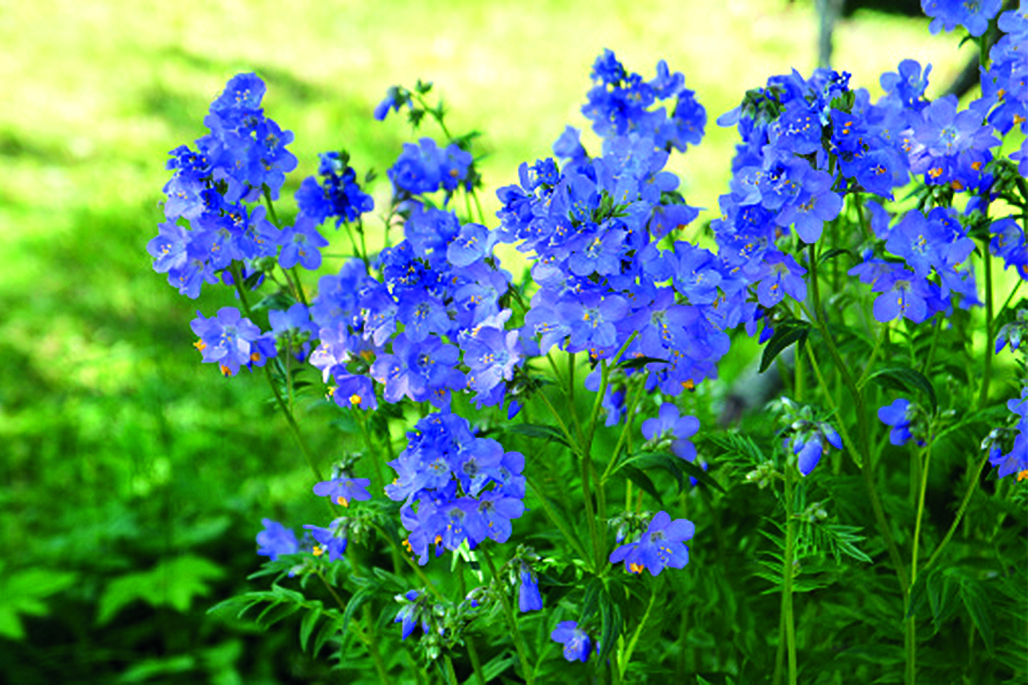
Introduction. Blue Polemonium (Polemonium cаeruleum L.) is the only representative of the Lilac family, which is allowed for use in medical practice. Blue polemonium rhizomes with roots are used as an expectorant and sedative and are included in the State Pharmacopoeia XIV edition. The herb of the plant is used as a biologically active additive of sedative action, however, regulatory documentation for this type of raw material has not been developed so far.
Aim. Description of anatomical features required in the development of draft pharmacopoeial article for the formation of the section "Microscopy" and assessing the authenticity of plant raw materials "Polemonium cаeruleum herba".
Materials and methods. Several samples of blue polemonium, which were collected independently from cultivated plants (Polemonium cаeruleum L.) in 2022 and 2023 during the period of mass flowering on the territory of the Botanical Garden named after B. M. Kozo-Polyansky VSU (Voronezh), were used in this work. Microscopic analysis was performed in accordance with the requirements of the current regulatory documentation.
Results and discussion. It was found that epidermal cells of leaf, calyx and corolla of blue polemonium are twisted, elongated on peduncles. Trichomes are of two types. There are papillae-like outgrowths of epidermis along the leaf margin and on sepals. Mesophyll is represented by spongy tissue. The conducting system is predominantly of spiral thickening type. Stomata are of anomocytic type. Stem is rounded or with weakly expressed edges. Primary cortex of the stem is represented by collenchyma, storage parenchyma without inclusions, endoderm with Caspari girdles. The stem is of tubeless structure. Cambium consists of continuous rows of small cells. Phloem is represented by small cells, sieve tubes with satellite cells. Secondary xylem lacks heart-shaped rays, radially arranged vessels have thick walls. The medulla is represented by parenchyma cells with oil droplets. The petiole is triangular in outline with a deep notch at the top and long marginal outgrowths, where there is one small conducting bundle each. The central bundle is arc-shaped with inwardly curved edges with parenchyma lining. Conclusion. In the framework of the present study, anatomo-diagnostic features of blue polemonium herb were studied with the help of various methods of microscopic analysis. The obtained data will be used in the development of the draft pharmacopoeial article "Polemonium cаeruleum herb", namely for the formation of the section "Microscopy".
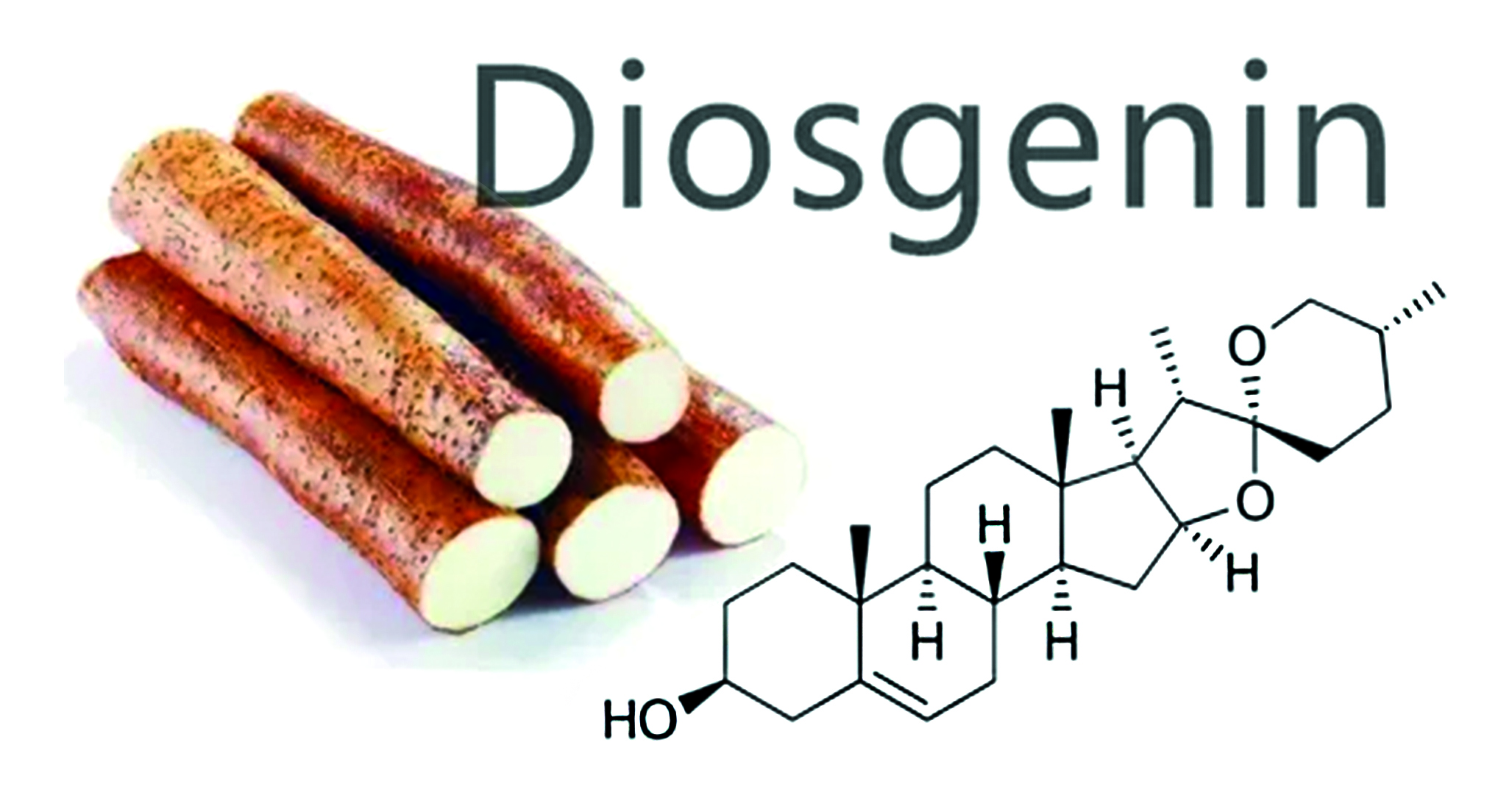
Introduction. The original article presents the results of an experimental study conducted using the method of high-performance thin-layer chromatography (HPTLC) on plant samples – rhizomes with roots of Dioscorea caucasica Lipsky and Dioscorea nipponika Makino. These species of Dioscorea are used in various fields of medicine as fungicides, antimicrobials, and anti-sclerotic agents. The HPTLC method is used at the screening stage of plant samples for preliminary identification and densitometric quantitative determination of diosgenin in plant extracts.
Aim. Development of a HPTLC methodology for quantitative assessment of diosgenin content after acid hydrolysis of extracts in air-dried raw materials – rhizomes with roots of Dioscorea caucasica Lipsky and Dioscorea nipponika Makino.
Materials and methods. The extracts were obtained by preliminary degreasing and depigmentation of air-dried rhizomes with roots of the studied Dioscorea species using high-purity dichloromethane, followed by double extraction. The first extraction was carried out in a 50 % aqueous solution of isopropanol with ultrasonication, followed by acid hydrolysis of O-glycosidic bonds and evaporation. The second extraction was carried out by redissolving the dry residue in methanol; it was purified from suspended particles by filtration through syringe filters with a perforation diameter of 20 μm. HPTLC was performed on a «CAMAG» (Switzerland) apparatus using HPTLC Aluminum sheets Silica gel 60 F254 20 × 20 cm, which were cut to a size of 20 × 10 cm.
Results and discussion. After performing scanning densitometry at 366 and 542 nm, it was established that the chromatography of methanol extracts in a toluene-chloroform-acetone solvent system (2 : 8 : 2 v/v) allows for satisfactory separation and subsequent densitometric quantitative determination of diosgenin. The tracks of plant extracts from the rhizomes and roots of Dioscorea caucasica Lipsky and Dioscorea nipponika Makino were compared with a standard sample of diosgenin.
Conclusion. The study found that the content of the steroid sapogenin diosgenin in air-dried Dioscorea nipponica Makino raw material (286,4–296,3 μg/g) slightly exceeds its content in Dioscorea caucasica Lipsky raw material (257–277,1 μg/g). The quantitative values obtained, calculated separately for peak height and area, show good convergence, confirming the correctness of the method. The developed method of high-performance thin-layer chromatography with densitometric detection of diosgenin can be recommended for routine quantitative analysis of this compound in plant raw materials.

Introduction. About 30 % of genetically engineered therapeutic proteins are produced in Escherichia coli. In the production of these proteins, cell viability is one of the key factors determining process efficiency and product quality. Controlling viability is essential when creating cell banks and optimizing E. coli cultivation conditions. Changes in cultivation parameters can affect viability and lead to shifts in the proportions of viable cells, dead cells, and cells undergoing apoptosis-like death (ALD). Flow cytometry is one method used to assess viability and distinguish between different cell populations.
Aim. To develop, validate and test a methodology for assessing the viability of E. coli using flow cytometry.
Materials and methods. To assess cell viability, we stained E. coli with propidium iodide (PI) and annexin V-FITC (An-V-FITC). We identified populations of live, dead, and ALD cells using dual staining with PI and An-V-FITC. The method was validated in accordance with the State Pharmacopoeia, the Decision of the EEC Council No. 85 dated 03.11.2016, and ICH guidelines. We evaluated the method’s applicability in developing conditions for cell bank creation and cultivation.
Results and discussion. We developed a method for assessing the viability of E. coli cells using flow cytometry and dual staining with PI and An-V-FITC, which enables the identification of live, dead, and ALD cell populations. Validation results demonstrated that the method meets the criteria: specificity (6 %), linearity (R2 > 0.9), accuracy (97–102 %), the limit of quantification (confirmed, 117 %), repeatability (1–10 %), intra-laboratory precision (2–17 %), analytical range (6.4–100 %). In selecting optimal conditions for cell bank creation, viability assessment enabled us to determine the optimal ratio of culture fluid to cryoprotectant (3 : 1) at an optical density of OD600 = 15, resulting in over 97 % viable cells after cryopreservation. During strain cultivation process development, the method facilitated the selection of optimal conditions. In the bioreactor, the proportion of dead cells increased by only 2.5 %, and the proportion of ALD cells increased by 7 % after 8 hours of induction.
Conclusion. We developed and validated a methodology for assessing E. coli viability that can be used during the development and production of therapeutic products.

Introduction. Phlorotannins are secondary metabolites produced mainly by brown seaweeds and belong to the class of polyphenolic compounds with diverse bioactivities. Storm-cast brown algae, a problem for coastal biocenoses, may be a valuable source of polyphenols. The Folin-Ciocalteu reagent (FCR) is the most commonly used for the quantification of total polyphenols in natural samples. Different spectrophotometric methods with FCR for the determination of phlorotannins in algae have been described in the literature.
Aim. The primary aim of this study is to standardize and validate the spec-trophotometric determination of total phlorotannins using FCR and demonstrate its applicability to analysis of storm-cast and fresh algae.
Materials and methods. A. nodosum samples were collected in sheltered beach on the Olenitsa Bay (66°27'15.7"N 35°18'20.4" E), Kandalaksha Gulf (White Sea, Russia) on two tidal levels: one located at low tide at a depth of 0.6–1.0 m (fresh) and the second was located at the supralittoral in the zone of wave splashing (storm-cast). Field sampling was carried out between June and September. The cleaned seaweed were transported to the laboratory, washed accu-rately with clean water, freeze-dried, ground into powder. Functional groups present in the algae were identified using Fourier Transform Infrared (FT-IR) spectroscopy. Spectrophotometric determination of total phlorotannins content (TPhC) with FCR was used and validated according to national and international guidelines.
Results and discussion. The optimum conditions for analysis time, wave-length, and standard substance were 45 min, 750 nm, and phloroglucinol, respec-tively. Under these conditions, validation by UV/Vis spectrophotometry proved the method to be linear (R2 > 0.99), specific, precise, accurate, reproducible, robust, and easy to perform. The limit of detection and limit of quantification were 0.005 and 0.02 mg/mL, respectively. For precision analysis, an intra-day test (RSD 2.16 %) and an inter-day test (RSD 2.84 %) were performed. Matrix effect assessment demonstrated that this had a negligible effect (1.9 %) on the phlorotannins quantification. TPhC in storm-cast algae ranged from 59 to 101 mg/g, while freshly collected algae were statistically significantly higher (p < 0.01) and ranged from 71 to 135 mg/g. Maximum accumulation of phlorotannins in A. nodosum was observed between July and August, after which a decrease was observed.
Conclusion. Results of current study could be utilised for routine analysis of TPhC in brown algae and storm-cast seaweed using optimized spectrophotometric method with FCR on readily available low-cost equipment in most laboratories to provide rapid. This methodology complies with the requirements for pharmaceutical analysis to ensure the reliability of results during pharmaceutical development and routine control both in fresh and storm-cast of A. nodosum.

Introduction. As a result of the search for more active polyfluoro-containing structural analogs of the non-steroidal antiandrogen flutamide against prostate cancer, a number of compounds were obtained, among which 2,2,3,3,4,4,5,5,6,6,7,7,8,8,9,9,9-heptadecafluoro-N-(4-nitro-3-(trifluoromethyl)phenyl)nonanamide (code F-4) was of the greatest interest for further study. The necessary data for rigorous proof of the molecular structure of this compound have not previously been obtained. Identification of impurities and quantitative assessment of their content in the F-4 substance have not been conducted. To address these issues, we used nuclear magnetic resonance (NMR) spectroscopy and high-performance liquid chromatography with ultraviolet (HPLC-UV) and tandem mass-selective detection (HPLC-MS/MS).
Aim. Comprehensive analysis of the structure of compound F-4 using NMR and HPLC methods, as well as identification and quantitative assessment using them of the content of impurities in samples of the substance.
Materials and methods. The object of the study were laboratory samples of the substance of compound F-4, obtained by acylation of 4-nitro-3-(trifluoromethyl)aniline with perfluoropelargonic acid chloride using a known method. The following were used for the analysis: NMR spectrometer Agilent DD2 NMR System 600; liquid chromatograph Agilent 1200 equipped with diode array detector G1315B; liquid chromatograph Agilent Infinity II equipped with mass spectrometric detector with triple quadrupole G6495C (Agilent Technologies, USA). Both chromatographs used a column Luna C18(2), 250 × 4.6 mm, 5 μm (Phenomenex, USA).
Results and discussion. Structural interpretation of the 1H, 13C, and 19F NMR spectra of F-4 samples, taking into account the chemical shift values of the signals, their multiplicity, and 2D experimental data, clearly indicates that F-4 has the structure of 2,2,3,3,4,4,5,5,6,6,7,7,8,8,9,9,9-heptadecafluoro-N-(4-nitro-3-(trifluoromethyl)phenyl)nonanamide. The 1H and 19F NMR spectra of the F-4 substance samples also contained signals of two impurity compounds not related to the starting materials. HPLC-UV method was used to separate them. Using HPLC-MS/MS with electrospray ionization in the negative mode (–ESI), high-intensity m/z signals characteristic of deprotonated molecular ions were recorded for all peaks. The structure of the detected impurities was confirmed using NMR spectroscopy. The results of quantitative determination of the relative impurity content in samples of F-4 substance using 1H and 19F NMR methods were virtually identical; the differences between the obtained average values were not statistically significant.
Conclusion. A comprehensive study using NMR and HPLC methods revealed that compound F-4 corresponds to the structure of 2,2,3,3,4,4,5,5,6,6,7,7,8,8,9,9,9-heptadecafluoro-N-(4-nitro-3-(trifluoromethyl)phenyl)nonanamide. Two related impurities were identified in samples of substance F-4, the relative content of each impurity did not exceed 1.7 %.

Introduction. Venous thromboembolism and atrial fibrillation are significant causes of vascular mortality. Anticoagulant therapy significantly reduces the risk of ischemic stroke, and dabigatran etexilate, a direct thrombin inhibitor, has become firmly established in clinical practice. There are several generic drug products of dabigatran etexilate capsules in Russia. Comparative dissolution kinetics test (CDKT) is one of the most critical quality control method for this dosage form. The use of biorelevant dissolution media can reliably predict the in vivo dissolution of the capsules. Based on the pharmacokinetic properties of dabigatran etexilate capsules, the most suitable medium is Fasted State Simulated Gastric Fluid (FaSSGF).
Aim. Development and validation of analytical methods for the quantitative determination of dabigatran etexilate using high performance liquid chromatography with diode array detection (HPLC-DAD) and UV spectrophotometry during the CDKT of dabigatran etexilate capsules in the biorelevant dissolution medium FaSSGF.
Materials and methods. Model solutions containing dabigatran etexilate pellets and excipients of the drug product were analyzed. An Agilent 1260 Infinity II Series HPLC-DAD (USA) was used for chromatographic separation. Detection of dabigatran was performed at 316 nm wavelength. A ZORBAX SB-C18, 150 × 4.6 mm, 5 µm column with ZORBAX SB-C18, 12.5 × 4.6 mm, 5 µm guard column (Agilent Technologies, USA) were used. An SF-2000 spectrophotometer (Russia) was used for the development and validation of UV spectrophotometry analytical method. Data obtained was processed using Agilent OpenLab CDS v. 2.7 and OKB Spectr Scanning for spectrophotometer SF-2000 v. 4.06.
Results and discussion. Optimal conditions for sample preparation, chromatographic and spectrophotometric conditions were developed for the quantitative assessment of dabigatran etexilate released into the FaSSGF dissolution medium during CDKT. Developed analytical methods were validated in the range from 0.13 to 14.67 μg/ml.
Conclusion. Developed analytical methods provide reproducible and reliable results over the entire specified range thus are suitable for the quantitative determination of dabigatran etexilate during CDKT in the biorelevant FaSSGF dissolution medium.

Introduction. Sea buckthorn leaves are currently used in pharmacy as a raw material for the production of the herbal medicinal product (HMP) "Giporamin" with antiviral action. The scientific literature contains data on preclinical trials of leaf extracts, confirming their anti-inflammatory, antibacterial, antioxidant, immunomodulatory activities, and there are also data on the potential properties of a hepatoprotector, which is associated with the phenolic, including flavonoid, fraction of the leaves. Therefore, studies of the possibility of additional ways of introducing the studied raw materials into practical pharmacy, as well as expanding the range of domestic HMPs containing a complex of biologically active substances (BAS) of leaves, for example, in the form of tinctures and liquid extracts based on leaves, with the development of methods for their standardization according to the target group of BAS should be considered relevant.
Aim. The aim of the study was to obtain and standardize aqueous-alcoholic extracts from sea buckthorn leaves.
Materials and methods. A comparative study was conducted for extracts from dried leaves prepared as tinctures (1 : 5) obtained in various ways and liquid extract (1 : 1) according to standard pharmacopoeial methods. All the studied extracts were prepared from leaves harvested in 2024 in the Voronezh region, at the phenological phase of development corresponding to the stage of technical maturity of the fruits. Methods for the identification and quantitative determination of flavonoids using TLC and differential spectrophotometry were developed.
Results and discussion. According to the «Dry residue» indicator, the tincture obtained by fractional maceration showed the highest amount of extractive substances. The liquid extract demonstrated the highest yield of biologically active substances. The content of heavy metals did not exceed the standards recommended by the State Pharmacopoeia of the Russian Federation. The content of flavonoids was maximum in the liquid extract (1 : 1). From the point of view of the efficiency of using raw materials, the best form is the tincture obtained by the percolation method.
Conclusion. Experimental laboratory samples of liquid aqueous-alcoholic dosage forms based on sea buckthorn leaves (tinctures, liquid extract) were obtained, their standardization was carried out according to the parameters set out in the regulatory documentation, and methods for the quantitative determination of flavonoids were developed. The TLC method showed a different flavonoid composition of aqueous-alcoholic extracts, which contain from 11 to 18 biologically active substances of the flavonoid group. The highest content of flavonoids was noted for the liquid extract (1 : 1), which allows us to recommend this form as the optimal one among those studied.

Introduction. Fennel fruits have pronounced carminative and antispasmodic activities due to the composition of the essential oil. The major component of the fennel fruits essential oil is phenylpropanoid trans-anethole. Its content in essential oil varies over a wide range. However, the Russian Pharmacopoeia XV does not provide for a standardization of anethole content for fennel fruits.
Aim. The aim is to develop and validate a spectrophotometric method for determining the amount of aromatic compounds in terms of anethole in the fennel fruits essential oil.
Material and methods. The fruits of common fennel (Foeniculum vulgare Mill.) produced by LLC Firma "Zdorovye" in 2024 were used as the object of the study. A UNICO-2802 spectrophotometer (Russia), ADV-200M analytical scales (Russia), GCMS-QP2010 Ultra gas chromatograph (Shimadzu, Japan) combined with a mass-selective detector were used in the work. An essential oil and a standard anethole samples were dissolved in 95 % ethanol during the spectrophotometric determination. The optical densities of the test solutions at 259 nm were determined in cuvettes with a layer thickness of 10 mm. The results of the spectrophotometric method were confirmed by gas chromatography.
Results and discussion. Validation of the presented method in accordance with the requirements of OFC.1.1.0012 "Validation of analytical methods" of the State Pharmacopeia XV edition was carried out. Its specificity, linearity, precision and correctness were showed. Results are not subject to systematic error. The relative standard deviation (RSD) does not exceed 2.0 %. The results of spectrophotometric determination of the amount of aromatic compounds in terms of anethole (46.5 ± 0.7 %) correlate with the results of GC analysis (48.6 ± 1.1 %).
Conclusion. The developed method for quantifying the amount of aromatic compounds in terms of anethole can be used to standardize both the fennel fruits themselves and the essential oil obtained from them.
PRECLINICAL AND CLINICAL STUDIES
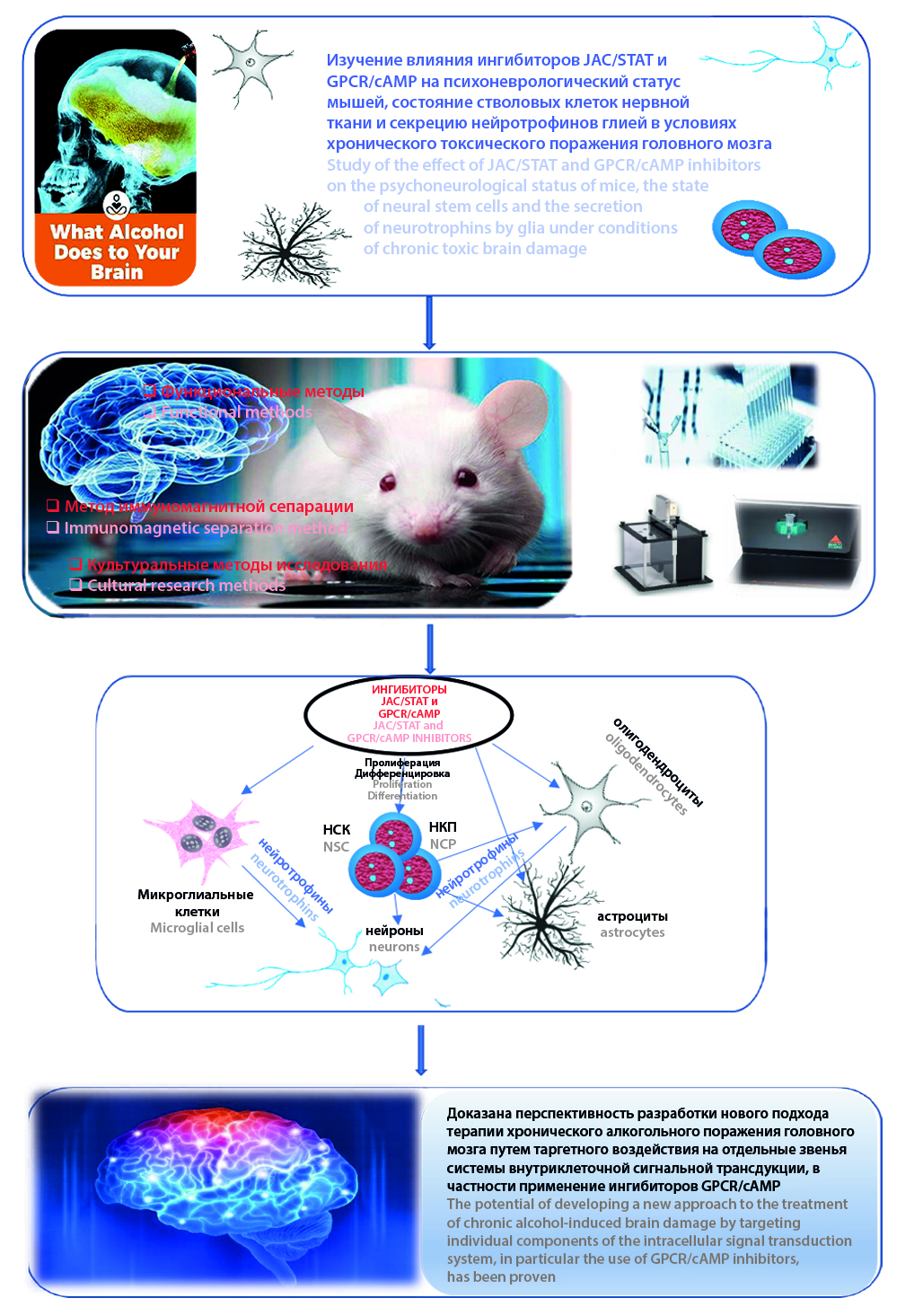
Introduction. Impaired central nervous system function resulting from chronic ethanol consumption is often associated with suppressed neurogenesis. The GPCR/cAMP-dependent pathway and JAK/STAT signaling are considered to be among the key signaling cascades involved in regulating the proliferation and differentiation of neural and neuronal stem cells. Clearly, the search for fundamentally new approaches to treating ethanol-induced neurodegeneration by targeting intracellular signaling molecules is highly relevant and in demand in practical medicine.
Aim. The aim of this study was to investigate the effect of JAC/STAT and GPCR/cAMP inhibitors on the psychoneurological status of mice, the state of neural stem cells, and the secretion of neurotrophins by glia under conditions of chronic toxic brain injury.
Material and methods. The studies were conducted on 90 C57BL/6 mice. Alcohol-induced neurodegeneration was modeled by per os administration of 30 % C2H5OH solution at a dose of 3 g/kg/day for 8 weeks. JAC/STAT and GPCR/cAMP inhibitors were administered subcutaneously once a day for 7 days at a dose of 15 and 10 μg/kg, respectively. The psychopharmacological effects of the blockers were assessed in the open field test and by the degree of preservation of the conditioned passive avoidance reflex. The content of neural stem cells and committed neuronal precursors in the subventricular zone of the brain, their proliferative activity and maturation intensity were studied using cultural methods; the production of neurotrophic factors by glial cells was investigated.
Results and discussion. The introduction of JAC/STAT and GPCR/cAMP inhibitors corrected the functional signs of alcoholic brain pathology (changes in exploratory behavior were abolished). At the same time, the course use of a GPCR/cAMP inhibitor leveled out, and the introduction of a JAC/STAT blocker aggravated the decrease in the level of reproduction of the conditioned passive avoidance reflex in alcoholized mice. In the groups of animals receiving JAC/STAT and GPCR/cAMP inhibitors, an increase in the number of neural stem cells and committed neuronal precursors was observed, accompanied by an increase in their mitotic activity and intensity of specialization. The introduction of a GPCR/cAMP inhibitor after modeling ethanol-induced brain damage was accompanied by an increase in the secretion of neurotrophins by astrocytes and microglia.
Conclusion. The obtained results indicate the prospects of developing a new approach to the treatment of chronic alcohol-induced brain damage by targeting individual links in the intracellular signal transduction system, in particular, the use of GPCR/cAMP inhibitors.
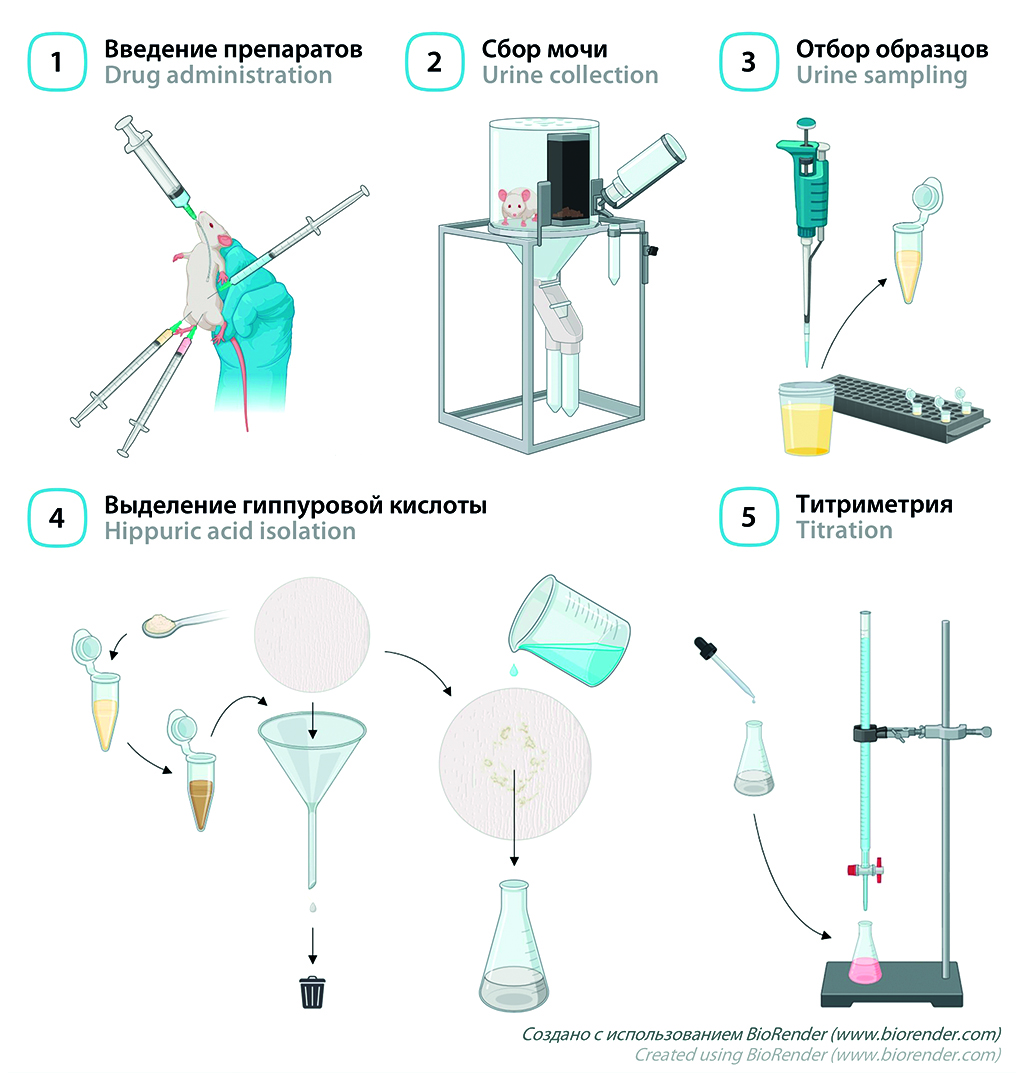
Introduction. Functional liver tests are a relevant group of methods for liver function screening, that can be used in a laboratory setting as well as in clinical practice. This group includes, among others, the Quick – Pytel test, which is based on the enzymatic formation of hippuric acid from glycine and benzoate in the liver. This test is minimally invasive and comparatively ease to perform, yet as of now, there is no detailed protocol to carry it out in small laboratory animals.
Aim. The objective of this work was to develop a protocol of the Quick – Pytel test to assess liver antitoxic function in small laboratory animals.
Materials and methods. Loading doses of sodium benzoate and glycine at an equimolar ratio (504 mg/kg and 264 mg/kg, respectively) were administered intraperitoneally to white outbred male mice (n = 10), after which urine samples were collected over 18 h in metabolic cages. Following sample preparation, the newly formed hippuric acid was titrated by 0.01 N potassium hydroxide in the presence of 1 % phenolphthalein. In 1 week, the mice were injected with carbon tetrachloride (1 mL/kg) to induce acute toxic hepatitis, and the test was repeated. Liver injury was confirmed morphologically with haematoxylin and eosin staining.
Results and discussion. Following carbon tetrachloride administration, urinary concentrations of hippuric acid decreased significantly (p < 0.01) by over 50 % from baseline. Liver samples exhibited characteristic features of acute toxic hepatitis.
Сonclusion. We have developed a protocol of the Quick – Pytel test in mice and confirmed its applicability to assess liver antitoxic function under acute injury conditions. The method we describe is simple and straightforward, is relatively low-cost, and can be used in routine practice to assess liver function in small laboratory animals.

Introduction. Patients diagnosed with pulmonary tuberculosis with multidrug-resistant or extensively drug-resistant pathogens (MDR-/XDR-TB) are characterized by reduced body weight (1, 2, 3). Under standard dosing regimens of antitubercular drugs, this can lead to altered pharmacokinetic parameters, increasing the risk of adverse reactions or reduced therapeutic efficacy. Therefore, mathematical modeling of the effect of body weight on the pharmacokinetics of the new domestic drug thiozonide is relevant for substantiating optimal dosing regimens.
Aim. To develop a mathematical model for assessing the influence of body weight on the pharmacokinetic parameters of thiozonide and to analyze the modeling results for individualized dosing approaches.
Materials and methods. The Julia programming environment and the Pumas.jl package were used for modeling. A two-compartment pharmacokinetic model with first-order kinetics and absorption, modified by the Weibull function, was developed. For each scenario, groups of patients with different fixed body weights (40, 50, 60, 70, and 80 kg) were considered, and 10 000 simulations were performed.
Results and discussion. Analysis of the simulation results showed that the maximum drug concentration (Cmax) increased as body weight decreased; however, the maximum relative difference between the extreme groups (40 and 80 kg) was 17,08 %. Minimum concentrations (Ctau) remained stable across all groups, showing relative changes of less than 2,5 %. The area under the concentration-time curve (AUCtau) varied from 2,88 to 7,23 %.
Conclusion. The study confirmed that there is no need to adjust the dosing regimen of thiozonide for patients weighing 40 to 80 kg.

Introduction. One of the most pressing areas of modern pharmacy is the creation of highly effective and safe drugs. The search for antitumor agents, driven by the increasing incidence of cancer, is focused on obtaining targeted drugs. 2-aminopyrrole derivatives synthesised at the Perm State Pharmaceutical Academy have demonstrated high cytostatic activity due to the activation of the mechanism of tumour cell apoptosis in the M phase. Preclinical studies should include toxicometry and determination of the pharmacokinetic parameters of the most active compound, 2-ANPC.
Aim. To study acute toxicity in experiments on mice and rats and the pharmacokinetic parameters of 2-ANPC after a single administration to Wistar line rats.
Materials and methods. The assessment of acute toxicity upon oral administration, with LD50 calculation using Finney's probit analysis method, was conducted in experiments on white non-linear mice and Wistar line rats. The pharmacokinetic parameters of 2-ANPC were studied in male Wistar line rats after administration of the compound per os. A validated method based on high-performance liquid chromatography with tandem mass spectrometry detection (HPLC-MS/MS) was used for the quantitative determination of 2-ANPC in the blood plasma of animals.
Results and discussion. The LD50 of the compound after a single oral administration was determined to be 4434 mg/kg for mice and 1547 mg/kg for rats. The time to reach the maximum concentration of 2-ANPC in rats after a single administration of 150 mg/kg is 2,90 ± 0,32 h, and the half-life of the compound from the body is 4,50 ± 0,49 h. The calculated apparent volume of distribution, which significantly exceeds the anatomical volume, indicates the predominant localisation of the substance in the extravascular space.
Conclusion. The study of acute toxicity in mice established that 2-ANPK belongs to toxicity class 4 (low-toxicity substances) according to the Hodge and Sterner classification and to hazard class 5 of chemical products based on their impact on the body. In an experiment on rats, the pharmacokinetic parameters of 2-ANPC after oral administration were evaluated. The data obtained show the potential for developing an oral dosage form based on this new 2-aminopyrrole derivative with proven antitumor activity.

Introduction. Hepatotoxicity is primarily-caused by oxidative stress and mitochondrial dysfunction; and, it is the principal factor that restricts the clinical efficacy of cyclophosphamide (Cpd), which is a chemotherapeutic drug that is frequently-used. The antioxidant capabilities have been demonstrated by dapagliflozin (Dapa), which is an inhibitor of sodium-glucose co-transporter-2 (SGLT2). Silymarin (Sil) is a chemical that is extracted from milk thistle. Researches have demonstrated that silymarin has hepatoprotective and antioxidant properties.
Aim. This study aimed to compare the hepatoprotective effects of dapagliflozin to silymarin in a rat model of Cpd-induced liver injury.
Material and methods. Negative control, vehicle (2 % aqueous sodium carboxy methylcellulose CMC), Cpd (30 mg/kg/ day, Intraperitoneal (ip), Dapa + Cpd (3 mg/kg/day, oral), and Sil + Cpd (200 mg/kg/day, oral) were the five groups that were randomly assigned to fifty rats. Each group consisted of ten rats. Following a period of ten days, evaluation the levels of alanine aminotransferase (ALT) and aspartate aminotransferase (AST) in the serum; while, malondialdehyde (MDA), reduced glutathione (GSH), and superoxide dismutase (SOD) enzyme were all measured in liver tissues; and histological inspection was also performed on the samples.
Results and discussion. Levels of ALT, AST, and MDA were each considerably-increased by Cpd, while the levels of GSH and SOD were decreased (P < 0.05). Treatment with either Dapa or Sil each with Cpd resulted in a significant amelioration of these alterations (P < 0.05 compared to controls). The results of the study demonstrate that Dapa was more effective than Sil in lowering MDA levels and increasing of GSH and SOD levels (P < 0.05). In the Dapa (Group IV), the histological examination revealed that the hepatic architecture had been intact, and there was only slight increase in vascular congestion.
Conclusion. Both dapagliflozin and silymarin each confer comparable hepatoprotective effects against Cpd-induced liver injury, possibly through attenuation of oxidative stress and preservation of hepatocyte integrity. The study adds to current evidence supporting the use of each of these agents in hepatic injury models. However, unlike the study of Satyam et al (2024) which investigated their combined effect, this study highlights their individual efficacy in a cyclophosphamide-specific toxicity model.
ANNIVERSARY

OBITUARY
ERRATUMS
Drug development & registration. 2025;14(2):54–74. (In Russ.) https://doi.org/10.33380/2305-2066-2025-14-2-2084. Published: 20.05.2025.
Drug development & registration. 2025;14(4):101–107. (In Russ.) https://doi.org/10.33380/2305-2066-2025-14-4-2195. Published: 24.10.2025.

ISSN 2658-5049 (Online)